

Battery protection fuse links for BESS
Battery protection fuse links are DC protective devices designed for battery energy storage systems. gBat fuse links cover overloads and short circuits; aBat fuse links provide short-circuit protection.
DF Electric’s battery protection fuse links bring together cylindrical and NH formats for battery energy storage systems (BESS). The family includes cylindrical gBat fuse links at 600 V DC, NH gBat fuse links at 440/550, 1000 and 1500 V DC, and NH aBat fuse links at 1500 V DC. Designed for battery circuits with different electrical and installation requirements, these ranges cover rated currents from 2 to 1250 A across the family. Each size and version has its own current range, voltage rating, breaking capacity and connection requirements. The highest values do not apply to every fuse link. gBat fuse links provide overload and short-circuit protection. aBat fuse links provide short-circuit protection and require coordinated overload protection. Correct selection also considers maximum system voltage, prospective fault current, DC time constant, temperature, charge/discharge cycles and the installation’s conductors. Explore the five ranges below, compare their electrical ratings and consult the technical documentation for the selected reference. The range pages provide the detailed data needed to assess fuse characteristics and installation requirements.


Cylindrical gBat fuse links provide overload and short-circuit protection for battery circuits at 600 V DC. The range includes 14 × 51 mm fuse links from 2 to 40 A and 22 × 58 mm fuse links from 40 to 80 A. Selected ratings are available with a striker for use with compatible fuse bases and microswitches.
| Main function |
|---|
| Protection against overloads and short circuits |
| Typical applications |
|---|
| Battery circuits requiring cylindrical fuse links |
| Range |
|---|
| 14 × 51 gBat 600 V DC 22 × 58 gBat 600 V DC |

NH gBat fuse links in this range cover rated currents from 20 to 630 A. NH000 and NH00 versions are rated at 440 V DC; NH1, NH2 and NH3 versions are rated at 550 V DC. They provide overload and short-circuit protection, with a rated breaking capacity of 30 kA.
| Main function |
|---|
| Protection against overloads and short circuits |
| Typical applications |
|---|
| Battery systems at 440 or 550 V DC |
| Range |
|---|
| NH000 gBat 440 V DC NH00 gBat 440 V DC NH1 gBat 550 V DC NH2 gBat 550 V DC NH3 gBat 550 V DC |

NH gBat 1000 V DC fuse links provide overload and short-circuit protection in NH1 and NH3 sizes. NH1 covers 40 to 160 A, while NH3 covers 200 to 400 A. Both sizes have a rated breaking capacity of 100 kA. Their design is intended to withstand repeated battery charge and discharge cycles.
| Main function |
|---|
| Protection against overloads and short circuits |
| Typical applications |
|---|
| Battery systems at 1000 V DC |
| Range |
|---|
| NH1 gBat 1000 V DC NH3 gBat 1000 V DC |

For battery systems up to 1500 V DC, this gBat range covers 63 to 500 A across NH1 XL, NH2 XL and NH3 L formats. The NH3 L bolted blade version includes a striker. Rated breaking capacity is 100 kA for the standard blade versions and 50 kA for the NH3 L bolted blade version.
| Main function |
|---|
| Protection against overloads and short circuits |
| Typical applications |
|---|
| Battery systems up to 1500 V DC |
| Range |
|---|
| NH1 XL gBat 1500 V DC NH2 XL gBat 1500 V DC NH3 L gBat 1500 V DC NH3 L gBat bolted blade with striker |

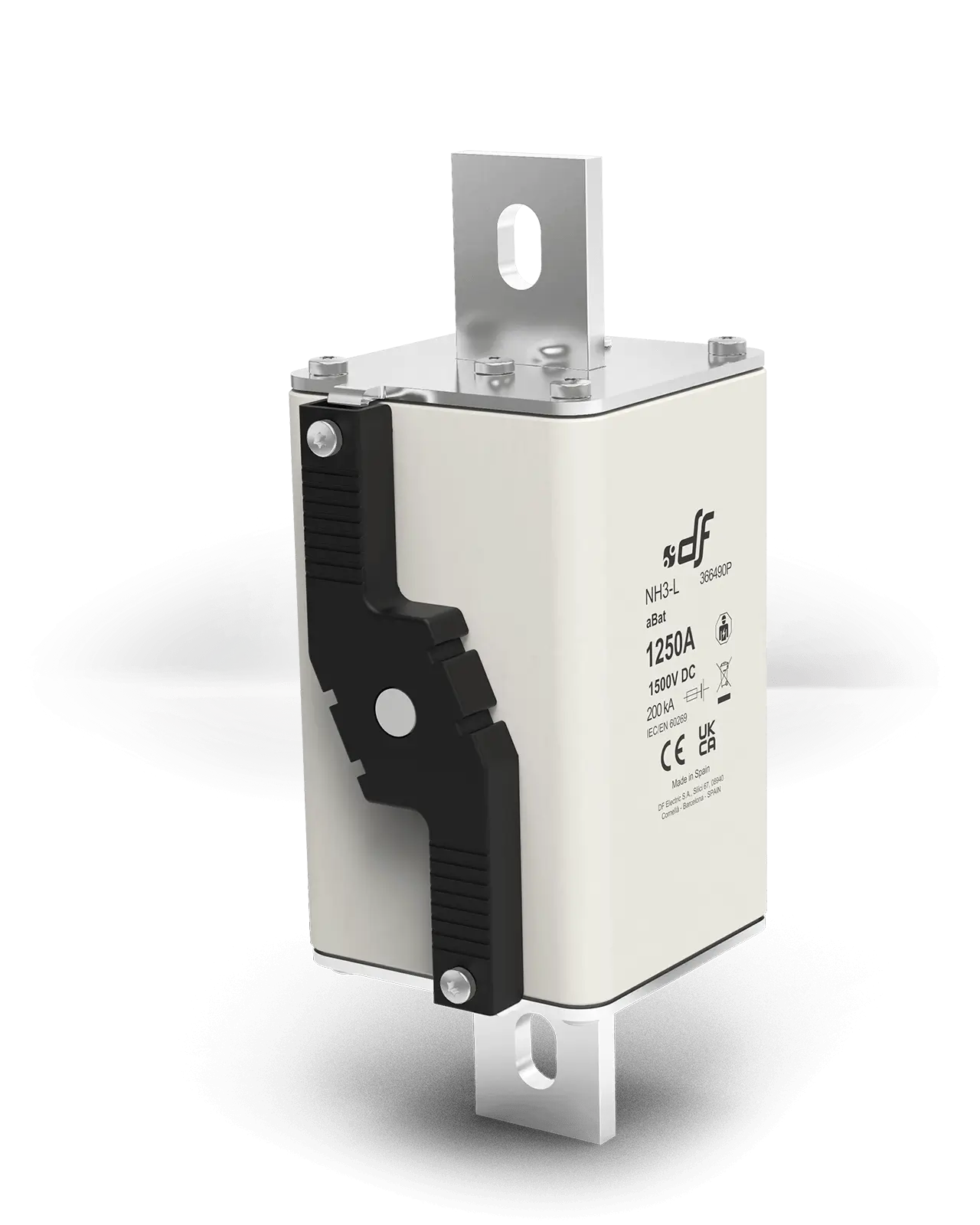
NH aBat fuse links provide short-circuit protection for BESS at 1500 V DC. The NH3 L range covers 250 to 1250 A, with bolted blade or flush end contacts and a rated breaking capacity of 200 kA. A striker provides visual indication and can operate a mounted microswitch. These fuse links require coordination with overload protection.
| Main function |
|---|
| Protection against short circuits |
| Typical applications |
|---|
| BESS requiring short-circuit protection at 1500 V DC |
| Range |
|---|
| NH3 L aBat bolted blade NH3 L aBat flush end contact |
What is the difference between gBat and aBat battery fuse links?
gBat fuse links provide full-range protection against overloads and short circuits. aBat fuse links provide short-circuit protection and require coordinated overload protection. Compare voltage, current, format and breaking capacity to identify the appropriate range, then check the technical data for the selected reference.
Comparison table
DF Electric battery protection fuse links
 |
 |
 |
 |

|
|
| Feature | Cylindrical gBat 600 V DC |
NH gBat 440/550V DC |
NH gBat 1000 V DC |
NH gBat 1500 V DC |
NH aBat 1500 V DC |
|---|---|---|---|---|---|
| Protection type | Protection against overloads and short circuits | Protection against overloads and short circuits | Protection against overloads and short circuits | Protection against overloads and short circuits | Protection against short circuits |
| Rated voltage | 600 V DC | 440/550V DC1 | 1000 V DC | 1500 V DC | 1500 V DC |
| Rated current | 2–80 A | 20–630 A | 40–400 A | 63–500 A | 250–1250 A |
| Breaking capacity | 50 kA | 30 kA | 100 kA | 100 kA / 50 kA2 | 200 kA |
| Sizes / versions | 14 × 51 mm 22 × 58 mm |
NH000 NH00 NH1 NH2 NH3 |
NH1 NH3 |
NH1 XL NH2 XL NH3 L NH3 L Bolted blade |
NH3 L Bolted blade NH3 L Flush end contact |
| DC time constant L/R | ≤ 3 ms | ≤ 10 ms | ≤ 3 ms | ≤ 3 ms | ≤ 3 ms |
1 NH gBat 440/550V DC. NH000 and NH00 are rated at 440 V DC; NH1, NH2 and NH3 at 550 V DC.
2 NH gBat 1500 V DC. 100 kA for standard blade versions; 50 kA for the NH3 L bolted blade version.
Breaking capacities apply under the stated DC time constant (L/R) conditions. Check the technical data, time-current curves, connection requirements and correction factors for the selected reference.
Applications of battery protection fuse links
Battery protection fuse links are used in DC battery circuits with different voltage levels, current ratings and monitoring requirements. The following applications describe selection contexts; the suitability of a specific reference depends on the electrical and installation conditions.
01
Battery energy storage systems
Battery protection fuse links are designed for BESS circuits. The required protection class, DC voltage and current rating determine which range and reference should be considered.
02
Battery circuits and cables
gBat fuse links provide protection against both overloads and short circuits. Their full-range protection can serve battery circuits, cables and associated equipment when correctly selected and coordinated.
03
1500 V DC battery systems
NH gBat and NH aBat ranges provide options for systems up to 1500 V DC. Protection class, breaking capacity and connection format must be checked for the selected version.
04
BESS circuits with higher current ratings
The NH aBat 1500 V DC range includes ratings from 250 to 1250 A. These fuse links provide short-circuit protection and must be coordinated with the system’s overload protection.
05
Repeated charge and discharge cycles
Battery systems experience changing current during charging and discharging. Selection must take the operating profile into account, using the correction factors documented for the chosen range.
06
Installations requiring fuse monitoring
Selected striker-equipped versions can actuate a compatible microswitch to signal fuse operation. Check the fuse link, connection arrangement and monitoring accessory required for the application.
Why choose DF Electric battery protection fuse links
DF Electric’s BATTERY PROTECTION family combines dedicated protection classes, multiple fuse formats and technical documentation for battery energy storage systems. The five ranges provide different voltage, current and connection options, while their data sheets define the conditions that govern selection and installation.
01
Dedicated battery protection classes
The family distinguishes gBat full-range protection from aBat short-circuit protection. This allows the protection function to be considered explicitly when selecting a fuse link.
02
Cylindrical and NH formats
The range combines 14 × 51 and 22 × 58 mm cylindrical fuse links with several NH sizes, including XL and L formats for the 1500 V DC ranges.
03
DC ratings defined by range
Rated voltages, breaking capacities and DC time-constant conditions are documented for each range. The technical data makes differences between sizes and versions visible.
04
Guidance for cyclic operation
The NH aBat documentation includes correction factors for temperature, conductor size and charge/discharge frequency. These support selection for the actual installation conditions.
05
Indication and connection options
Available options include striker-equipped fuse links, bolted blades and flush end contacts. Their availability depends on the selected range and reference.
06
Reference-specific technical documentation
Product pages and data sheets provide electrical ratings, dimensions, characteristic curves and installation information. Selection can therefore be based on documented product data.
Need to know
What products are included in the BATTERY PROTECTION family?
The family includes cylindrical gBat fuse links at 600 V DC, NH gBat fuse links at 440/550, 1000 and 1500 V DC, and NH aBat fuse links at 1500 V DC. Available sizes and contact formats depend on the range.
What is the difference between gBat and aBat fuse links?
gBat fuse links provide protection against both overloads and short circuits. aBat fuse links provide short-circuit protection and require coordinated overload protection. DF Electric’s NH aBat 1500 V DC range has a minimum breaking current of 10 times its rated current; it must not be treated as a full-range overload protective device.
How do I choose a fuse link for a battery energy storage system?
Selection depends on maximum DC voltage, operating current, prospective fault current, DC time constant, protection class and installation conditions. Also check time-current curves, I²t, charge/discharge cycles, temperature, conductor size and connection format. Use the selected range’s technical data to apply correction factors and verify coordination with the rest of the system.
Which battery fuse links are available for 1500 V DC?
DF Electric offers NH gBat 1500 V DC fuse links from 63 to 500 A and NH aBat 1500 V DC fuse links from 250 to 1250 A. They differ in protection class, contact options and breaking capacity. The required protection function must be considered alongside voltage and current.
Which NH gBat fuse links are rated at 440 V DC or 550 V DC?
In the NH gBat 440/550 V DC range, NH000 and NH00 fuse links are rated at 440 V DC. NH1, NH2 and NH3 fuse links are rated at 550 V DC. The voltage rating is specific to the size and reference; 550 V DC does not apply to the entire range.
Do charge and discharge cycles affect battery fuse selection?
Yes. Repeated current variations cause heating and cooling of the fuse element and can contribute to mechanical fatigue. DF Electric’s NH aBat selection guide includes a correction factor for cycling frequency. Apply the guidance for the selected range and the actual operating profile rather than choosing solely by nominal load current.
How does ambient temperature affect the rated current I can use?
The technical documentation for these ranges requires current derating when the ambient temperature exceeds 25 °C. Use the correction factors specified for the selected fuse link. The declared operating temperature range does not mean the fuse can continuously carry its full rated current at every temperature within that range.
What are the striker and microswitch used for?
A striker indicates that a fuse link has operated and, in a compatible assembly, can actuate a microswitch for remote signalling. Striker versions are available for selected cylindrical gBat ratings and NH gBat 1500 V DC bolted blade versions. NH aBat fuse links also have a striker and can accept a mounted microswitch.
Which standards are listed for DF Electric battery protection fuse links?
The range data sheets reference IEC/EN 60269-1 and IEC 60269-7. Consult the technical documentation for the selected reference to confirm the applicable standards, electrical ratings and installation requirements.