

Photovoltaic solar energy has become one of the pillars of the global energy transition
Solar farms and self-consumption installations are growing exponentially, driven by the reduction in panel costs, the rise of energy storage and decarbonisation policies. However, this technological progress brings a key responsibility: ensuring that systems are safe, efficient and durable. Electrical protection plays a crucial role here, with photovoltaic fuses at the forefront.
In this article, we guide you on how to choose the right solution, with a special focus on the HORUS range by DF Electric, designed to meet the demands of the most advanced solar installations.
The Importance of Adequate Protection in Solar Installations
Solar installations operate primarily in direct current (DC), introducing additional challenges compared to traditional alternating current (AC) systems.
Key risks include:
-
Persistence of the energy source
Solar panels continue to generate electricity as long as they are exposed to sunlight, even in case of a fault.
-
Difficult arc extinction
In DC, the electric arc is more stable and harder to interrupt than in AC.
-
Harsh environmental conditions
Systems are exposed to heat, humidity, UV radiation, dust and other factors that can deteriorate components.
A fault without adequate protection can damage costly equipment (panels, inverters, batteries) and create electrical hazards or fire risks, endangering people and infrastructure.
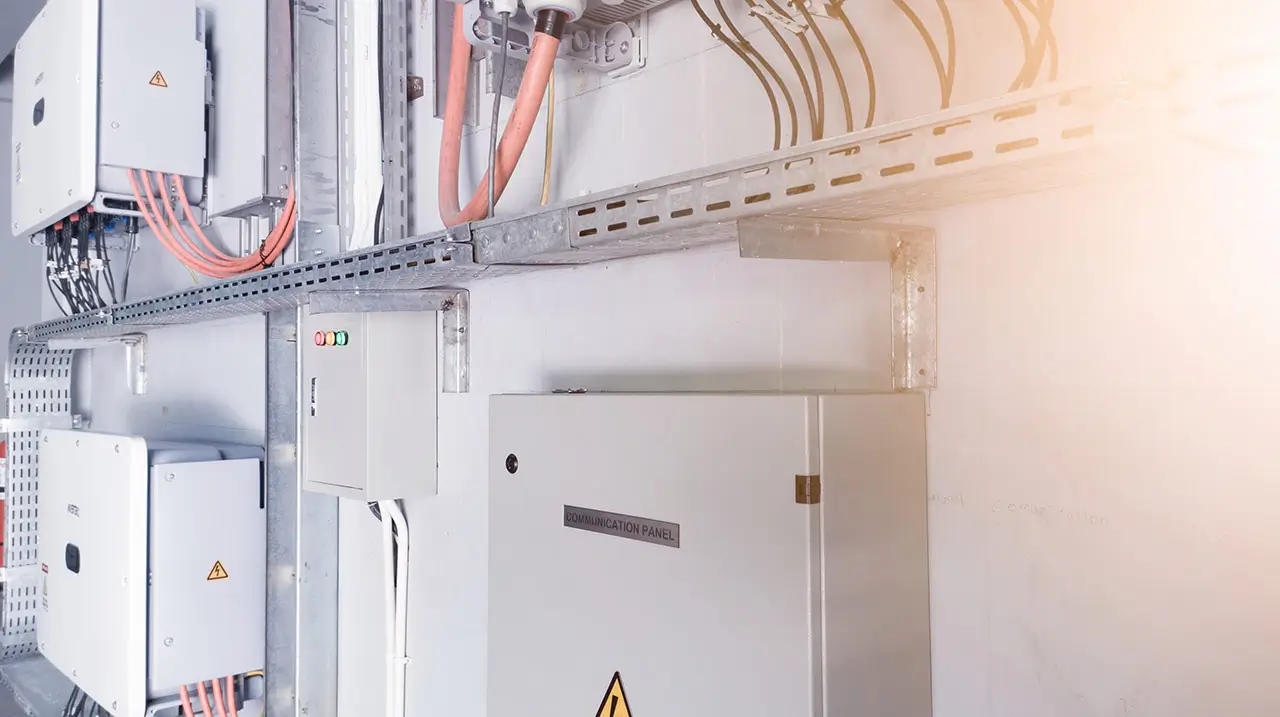
A photovoltaic installation without fuses specifically designed and certified for DC is a system vulnerable to serious and unpredictable failures that jeopardise safety and service continuity.
A professional design must include correctly selected and dimensioned fuses for each application — an area where the HORUS range from DF Electric stands out.
Why Choose Fuses Over Other Protection Devices in Photovoltaics?
Although alternatives such as circuit breakers exist, fuses specifically designed for photovoltaic applications offer clear advantages:
-
Ultra-fast response time
Fuses react in milliseconds to short-circuits, limiting damage to a minimum.
-
Simplicity and reliability
With no moving parts or complex mechanisms prone to wear or contamination.
-
High DC breaking capacity
Especially important in voltages above 1000 VDC, where arcs are harder to extinguish.
-
Cost-effective and easy replacement
Maintenance is simple, and spare parts are low-cost compared to other devices.
The HORUS fuses are designed to meet the requirements of modern photovoltaic applications, supporting voltages up to 1500 VDC and cutting capacities suited for high-power systems.
"The HORUS range is the result of comprehensive R&D, based on advanced technical criteria and designed to exceed international solar market standards for reliability, efficiency and safety.”
— Josep Durante. DF Electric R&D Manager
Key Considerations When Selecting Photovoltaic Fuses
Fuse selection should never be random. It must be based on:
1. Rated DC Voltage
Photovoltaic systems operate at increasingly higher voltages to improve efficiency and reduce losses. For example:
• Residential systems: typically up to 600 VDC
• Commercial and industrial systems: 1000 VDC
• Utility-scale plants: up to 1500 VDC
Fuses must be certified and tested to safely operate at these voltages.
The HORUS series by DF Electric offers fuses rated from 600 to 1500 VDC, with various sizes and rated currents, covering applications from small installations to large utility-scale plants.
2. Rated Current
The fuse must be sized above the maximum normal operating current of the string or protected circuit, while being sensitive enough to operate in the event of a fault. This requires a prior system study (expected short-circuit currents, module characteristics, operating conditions).
Engineers typically apply a 125% margin over the maximum string current when selecting the fuse.
3. Breaking Capacity
In solar systems with parallel strings, fault currents can be high since all healthy strings feed the short-circuit point. The fuse must be capable of interrupting these currents without sustaining the arc.
HORUS fuses feature a DC breaking capacity above 30 kA, ensuring effective performance.
4. Standards Compliance
The fuse must comply with IEC 60269-6, the standard specific to solar applications. This ensures it has been tested and validated to operate in direct current under the working conditions of a photovoltaic system.
"Each HORUS fuse undergoes rigorous electrical and mechanical testing to international standards, ensuring performance and reliability in real-world PV environments."
— Miquel Perez. DF Electric Laboratory Manager
HORUS: Advanced Protection for Photovoltaic Systems
The HORUS range by DF Electric, the result of decades of expertise in electrical protection, encompasses a complete line for photovoltaic installations:
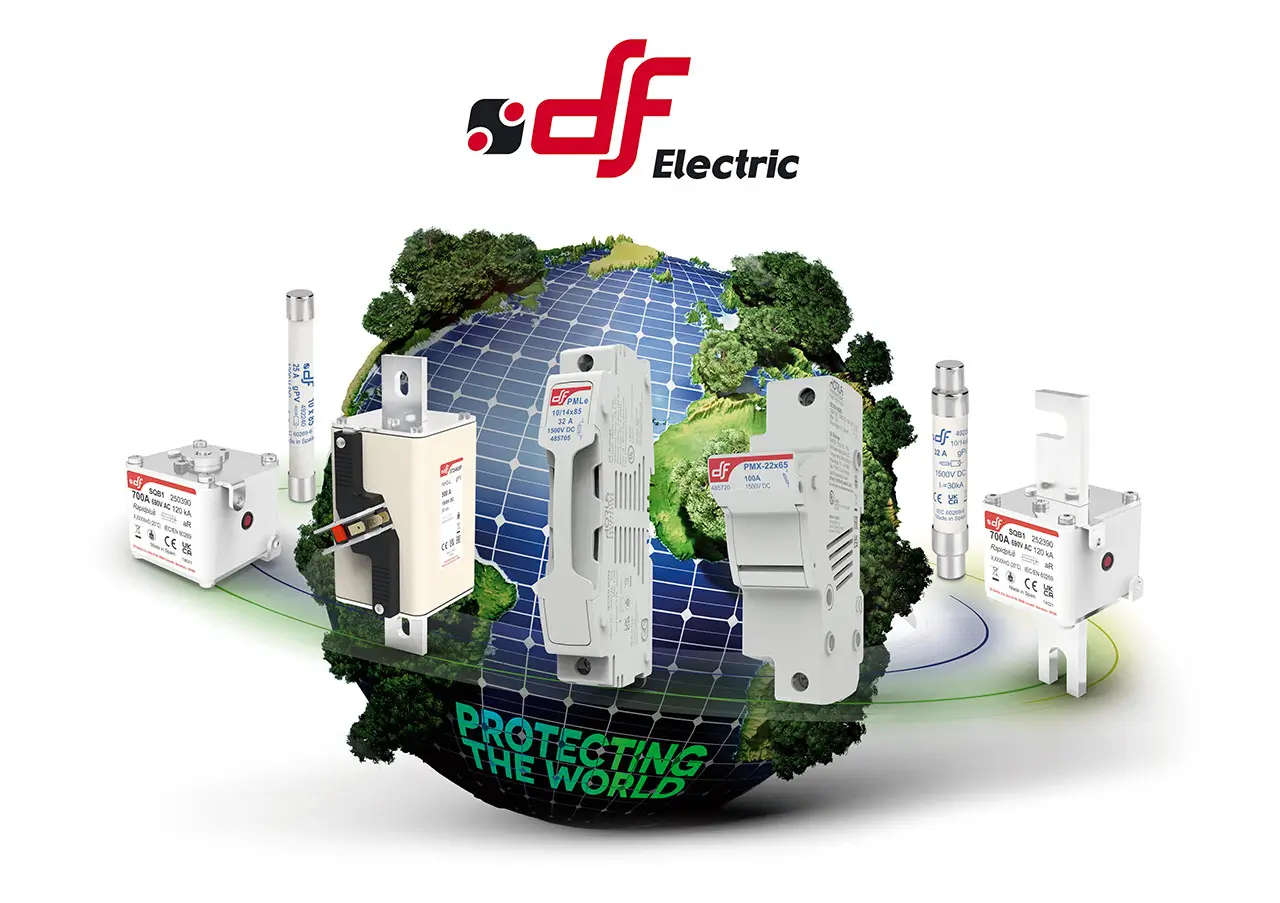
gPV Cylindrical Fuses
The gPV cylindrical fuses are specifically designed for the protection of photovoltaic strings, supporting voltages up to 1500 V DC and offering a breaking capacity of 30 kA in compliance with IEC and UL standards. They are available in 10×38 mm and 14×51 mm formats for voltages up to 1000–1100 V DC, 10×85 mm and 10/14×85 mm formats for up to 1200–1500 V DC, and 22×65 mm format for up to 1500 V DC, covering a wide range of rated currents from 1 A to 60 A, depending on size.
Their construction includes a high thermal shock-resistant ceramic tube, silver-plated copper contacts, and a pure silver fuse element, ensuring maximum reliability and durability under demanding conditions. Classified as gPV according to IEC 60269-6 and UL 248-19, they feature a characteristic curve that ensures fast operation at 1.35 times the rated current (In) and avoids operation at 1.05 times In, providing precise and safe protection against overcurrents and short-circuits.
They operate within a thermal range of –40 °C to +80 °C, with current derating applied above +25 °C. These fuses are compatible with PMX PV fuse holders, and some versions include visual indicators to facilitate maintenance and quick detection of blown fuses.

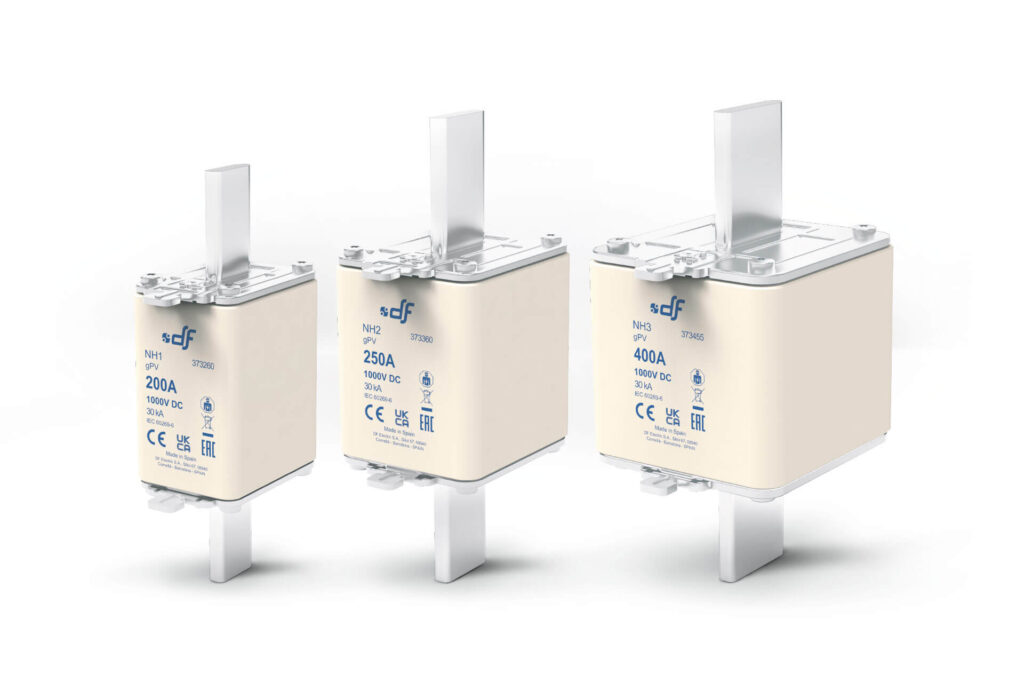
NH gPV 1000 VDC Fuses
The NH gPV 1000 VDC fuses are designed for the protection of medium-power solar arrays and fields, suitable for applications up to 1000 V DC. Available in NH1, NH2, and NH3 sizes, they cover rated currents from 25 A to 400 Awith a breaking capacity of 30 kA in accordance with IEC and UL standards.
They feature a ceramic body resistant to thermal shocks, silver-plated copper contacts, and a pure silver fuse element for high thermal and mechanical reliability. Classified as gPV under IEC 60269-6 and UL 248-19, they provide fast operation at 1.35 In and no operation at 1.13 In, delivering precise and safe protection against overcurrents and short-circuits.
Operating temperature range is –40 °C to +80 °C, with derating applied above +25 °C. Versions with striker contacts allow for the integration of microswitches for remote fuse status indication, aiding maintenance and monitoring. These fuses are optimised for use with NH ST 1000 VDC fuse bases, suitable for DIN rail or screw mounting, ensuring a safe and reliable installation.

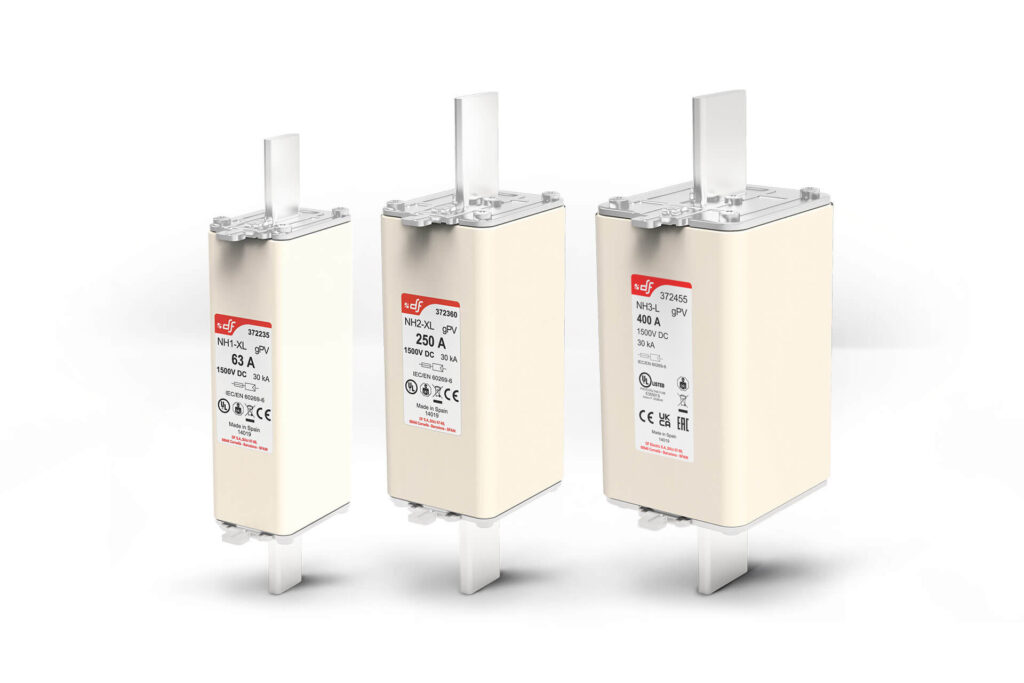
NH XL gPV 1500 VDC Fuses
The NH XL gPV 1500 VDC fuses are ideal for protecting high-power strings and inverter DC inputs in photovoltaic systems. Available in NH1 XL, NH2 XL, and NH3 L sizes, they cover rated currents from 40 A to 500 A, with a breaking capacity of up to 100 kA (IEC) and 30 kA (UL) in standard versions (striker versions offer up to 50 kA IEC).
They are offered with blade contacts for standard NH bases or bolted striker contacts that allow connection of a microswitch for fuse status indication, improving diagnostics and installation safety. Classified as gPV under IEC 60269-6 and UL 248-19, they have a characteristic curve for fast operation at 1.35 In and no operation at 1.13 In, ideal for protecting against overcurrents and short-circuits in systems up to 1500 V DC.
Their construction combines a ceramic body with high thermal shock resistance, silver-plated copper contacts, and a pure silver fuse element, ensuring durability, electrical reliability, and low thermal losses even under the most demanding conditions.

NH gG 800 VAC Fuses
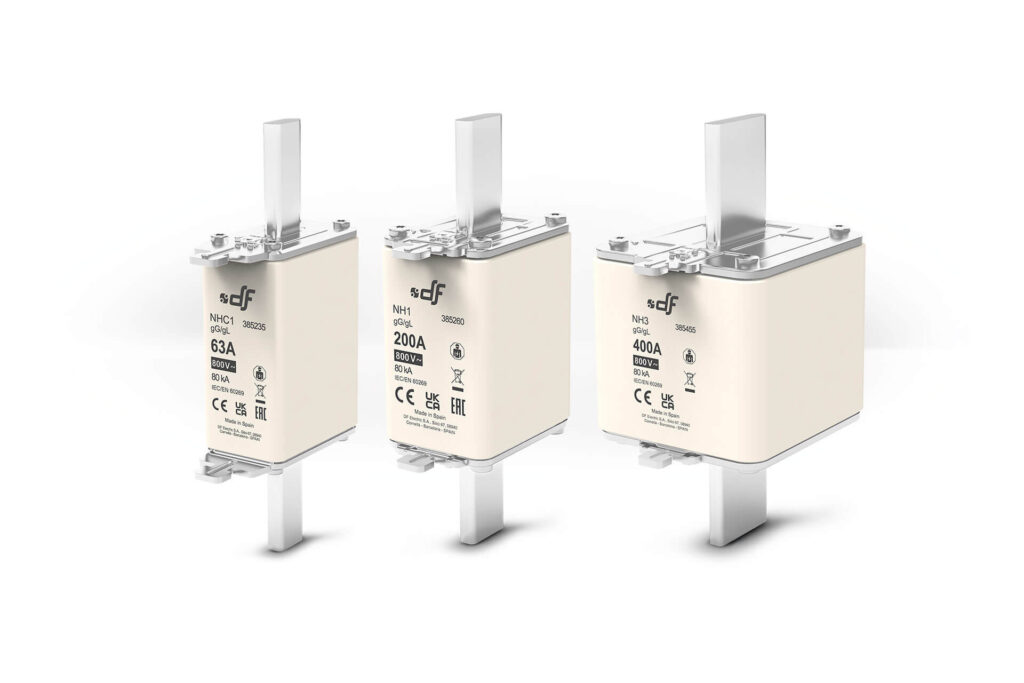
NH gG 800 VAC fuses are ideal for protecting the output of next-generation string inverters, capacitor banks, and other low-voltage power applications. Rated for up to 800 V AC (+10%), they offer a breaking capacity of 80 kA, meeting IEC/EN 60269-1/2 standards.
Available in NHC1, NH1, and NH3 sizes with rated currents from 25 A to 400 A, their construction features a high-strength ceramic body able to withstand internal pressures and thermal shocks, silver- or nickel-plated copper or brass blade contacts, and a silver-plated copper fuse element for stable, long-lasting performance.
They operate at frequencies from 42 to 62 Hz and ambient temperatures from –40 °C to +80 °C, with derating applied above +25 °C. Compatible with NH ST open bases and BS-type three-pole disconnectors, they integrate easily into various panel configurations.
NH gS 800 VAC Fuses
NH gS 800 VAC fuses are specifically designed for protecting the output of new-generation string inverters, with rated voltages up to 800 V AC +10%. Classified as gS under IEC/EN 60269-1/4, they provide an outstanding breaking capacity of 120 kA, ideal for managing high-magnitude overcurrents and short-circuits.
Available in NH00, NH1, and NH3 sizes, they cover rated currents from 25 A to 400 A. For example, the NH1 series offers 100 A, 125 A, 160 A, and 200 A, while NH3 ranges from 250 A to 400 A.
Their ceramic body withstands internal pressure and thermal shocks, with silver- or nickel-plated copper or brass blade contacts ensuring high mechanical and electrical reliability.
Suitable for frequencies 42 to 62 Hz, ambient temperatures –40 °C to +80 °C, with current derating above +25 °C. Compatible with NH ST open bases and BS-type three-pole disconnectors, providing installation versatility.

PMX PV Modular Fuse Holders
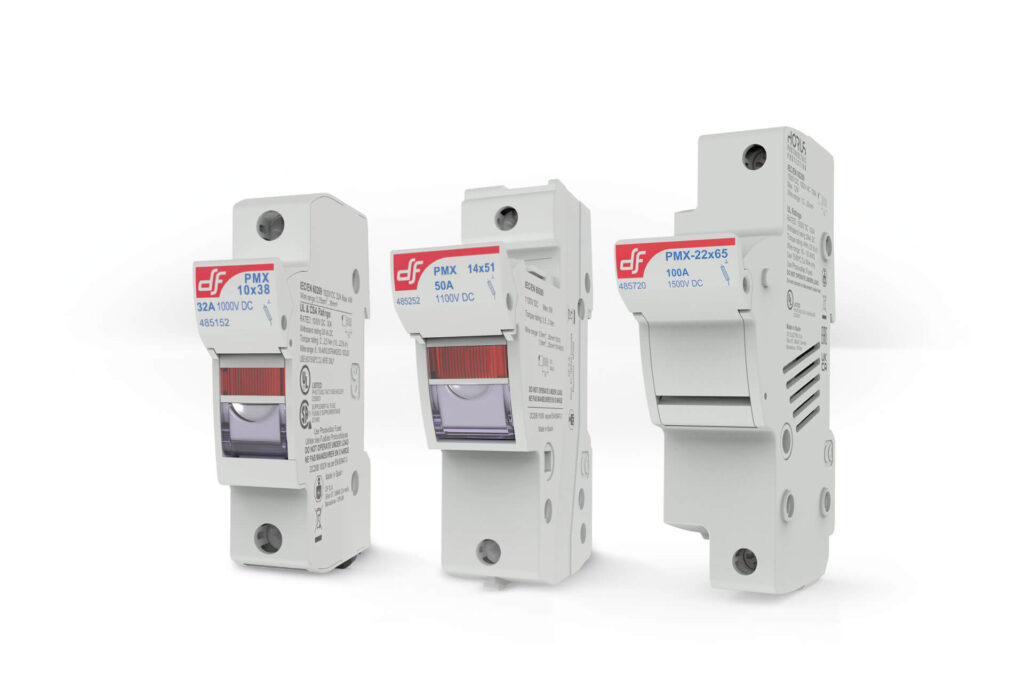
PMX PV fuse holders are designed for DC photovoltaic string installations, offering a modular, safe, and robust solution for gPV cylindrical fuses. Suitable for 10×38 mm and 14×51 mm fuses rated 1000–1100 V DC, and 22×65 mm fuses for up to 1500 V DC.
Made from halogen-free, self-extinguishing thermoplastics, compliant with RoHS, they support quick DIN rail mounting and feature an integrated handle for safe fuse removal. Available in 1P and 2P versions, they offer IP20 protection (enhanceable with accessories).
Rated currents: 32 A (10×38), 50 A (14×51), 100 A (22×65). Optional accessories: multipole coupling pins, lockout padlocks, terminal IP20 protectors for additional safety and versatility.
PML-e Fuse Holder
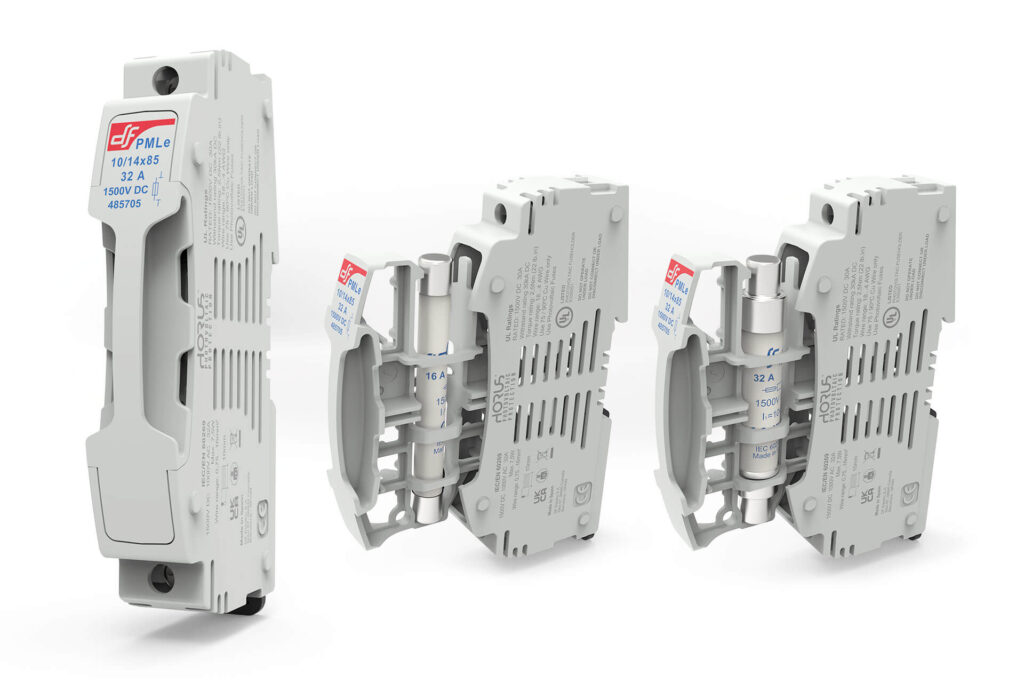
The innovative PML-e 10/14×85 PV fuse holder is designed for gPV cylindrical fuses 10×85 mm and 10/14×85 mm in applications up to 1500 V DC, offering a compact, safe, and efficient solution for PV strings. Made of high-quality materials, with silver-plated electrolytic copper contacts and a halogen-free, self-extinguishing thermoplastic body, RoHScompliant.
Rated up to 32 A, IP20 protection, 8 kV impulse withstand (pollution degree 3). Features ventilation for thermal dissipation, DIN EN50022 rail mounting, accepts 0.75 to 16 mm² flexible cables, torque 2–2.5 Nm.
Service temperature –40 °C to +70 °C, optional accessories: fine wire protectors, IP20 covers, lockout and tamper-proof systems. Weight 84.5 g, compliant with IEC/EN 60269-1/2, UL4248-1/19, UL486E.
NH ST 1000 VDC Fuse Bases
NH ST 1000 VDC fuse bases accommodate NH blade fuses for DC applications up to 1000 V DC. Available in NH1 (250 A), NH2 (400 A), NH3 (500 A) sizes, IEC/UL certified. Silver-plated copper contacts, flame-retardant thermoplastics, RoHS compliant, operation –20 °C to +70 °C (storage –40 °C to +80 °C), IP00/IP20 protection.
DIN rail/screw mounting, M12 cables, torque 32 Nm (base), 12 Nm (fixing). Max power dissipation: 32 W (NH1), 45 W (NH2), 60 W (NH3). Breaking capacity up to 120 kA. Accessory options: terminal covers, spacers, multipole systems for enhanced IP and custom setups.
Certified to IEC/EN 60269-1/2, UL4248-1/19, UL File E359201. Their versatility and robustness make them key components for medium and high-power photovoltaic panels.

NH XL 1500 V DC Fuse Bases
The NH XL 1500 V DC fuse bases are designed to accommodate NH XL gPV fuses (NH1 XL, NH2 XL, and NH3 L) intended for the protection of high-voltage arrays and inverter DC inputs. Manufactured from high-quality materials, they feature silver-plated copper contacts and self-extinguishing thermoplastics with high thermal resistance, compliant with RoHS requirements. They are designed for DIN rail mounting or panel bolt mounting, using M10/M12 terminals with tightening torque up to 32 Nm.
These bases are available in unipolar versions for rated currents of 200 A (NH1 XL), 315 A (NH2 XL), and 500 A (NH3 L), operating at voltages up to 1500 V DC. They feature double-spring clamp contacts ensuring a stable connection and allow for the simultaneous integration of IP20 protection accessories, such as terminal covers, fuse covers, and separation plates.
In terms of electrical performance, these bases withstand impulses up to 12 kV, provide short-circuit withstand capacity of 30 kA (UL) and up to 100 kA (IEC), and offer maximum power dissipation ranging from 45 W (NH1 XL 200 A), 75 W (NH2 XL 315 A) to 85 W (NH3 L 500 A). They are certified according to UL4248-1/19 (UL File E359201).
This model operates within a temperature range of –20 °C to +70 °C (storage –40 °C to +80 °C) and its design allows for multipole assemblies using compatible accessories. Dimensions vary depending on the model — for example, the NH1 XL base measures 260×235×77 mm and weighs 377 g — making integration into compact and modular electrical panels easier.

NH ST 800 V AC Fuse Bases
The NH ST 800 V AC fuse bases are designed to accommodate NH blade fuses in alternating current (AC) photovoltaic inverter protection applications. Manufactured with silver-plated electrolytic copper contacts and self-extinguishing thermoplastics, they comply with RoHS directives and IEC/EN 60269-1/2 standards.
They support rated currents of 160 A (NH00), 250 A (NH1), and 630 A (NH3), with a rated voltage up to 800 V AC. Available in single-pole and three-pole versions, they can be mounted on DIN rail or fixed using screws/brackets/nuts, and offer maximum power dissipation of 12 W (NH00), 25 W (NH1), or 60 W (NH3) depending on the size.

“HORUS was conceived as a comprehensive technical solution to ensure maximum reliability and safety in demanding solar environments, streamlining operations for installers and operators worldwide.”
— Amgad Gouhary. DF Electric International Sales Director
Where Are Photovoltaic Fuses Installed?
A professional system design must position fuses at key points in the installation:
At each string
Prevents a fault in one string from affecting the others, protecting the cables and the entire installation.
In combiner boxes
Where strings are grouped before reaching the inverter — this is typically where HORUS fuse holders are installed.
Inverter protection
A short-circuit at the inverter can be catastrophic if not properly protected.
Battery systems
Hybrid systems with storage require dedicated DC fuses on the battery side. The HORUS range offers ideal options for these applications.
Proper fuse placement and sizing minimise downtime and enhance the overall safety of the installation.

Current Trends in Photovoltaic Protection
The photovoltaic sector is evolving rapidly, directly impacting protection requirements:
-
More powerful and complex systems
Strings are grouped into higher-capacity systems, increasing the demands placed on fuses.
-
Greater storage integration
An increasing number of systems combine generation and batteries, requiring hybrid protection solutions.
-
Stricter regulations
The rise of self-consumption and large-scale plants has led to reinforced technical and regulatory requirements to protect people and assets.
-
Digitalisation and predictive maintenance
Operators are seeking solutions with clear status indicators and compatibility with preventive maintenance strategies.
The HORUS range meets these challenges, serving as a key partner for engineering firms, installers and solar plant operators.
[…] residential installations to large-scale utility projects, batteries have become the heart of the energy transition. However, along with new opportunities come new risks that must be managed with precision and […]